

The need of complex-shaped components with high levels of tolerances is unprecedented in the contemporary environment of the manufacturing industry. Such industries as automotive and electronics demand not only durable parts but also geometrically complicated. Shenzhen Lihao Machine Equipment Co., Ltd. is aware that the development of progressive stamping technology has played a central role in addressing these issues. Advanced stamping systems are progressive stamping machines that evolved to be advanced machines that can achieve very detailed parts within a short time and with repeatability. It is important to understand how these machines are able to maneuver through part geometry complexities by manufacturers in a bid to streamline production, as well as, retain their competitive advantage in the global market.
The Core Principles of Progressive Stamping for Complex Shapes
The basic principle of natural progressive stamping is a gradual change and therefore most suited with complex geometries. The material, usually a coil strip, passes through a sequence of stations as opposed to being shaped by a single, forceful strike. Every station has a given operation like punching, notching, bending or coining. The incremental method can enable the machine to deal with extreme material deformation without tearing or stress fractures. In the case of Shenzhen Lihao Machine Equipment Co., Ltd., it is the accuracy of the progressive die that is precise. Die The die is the pattern of the part and in a good quality machine the designation and coordination between die stations are such that even the most complicated curves, deep draws and minute details can be produced without any errors. This technique is used to deconstruct what would appear to be an impossible form into a series of tasks which are easy to manage, and each detail is made with impeccable precision.
Advanced Die Design and Material Flow Control
Complex geometries are thoroughly embedded in the expertise of the die design and material flow control. The stamping machines used in the modern progressive stamping, such as those supported by Shenzhen Lihao, are used together with the computer-aided design to design dies that would predict how the metal would act under the pressure of the stresses. In the creation of a complicated component, the metal should arrive flowing into channels and over a curve without buckling. This flow is controlled by use of features like draw beads and pressure pads which are strategically positioned in the die. The stamping press secures that the material spreads evenly by the control of tension and speed at which the material goes through the machine. This is especially essential to parts that have different depths or radius tightness. The stiffness of the machine and accuracy of the ram direction is equally important avoiding any undesirable motion that may induce a geometric distortion of the completed geometry.
Incorporating Automation and In-Die Processes
In order to achieve mastery level with regard to complex part geometry, progressive stamping lines have incorporated advanced automation and in-die processes. A current system such as that offered by a supplier such as Shenzhen Lihao Machine Equipment Co., Ltd. can do much more than mere cutting and forming. Complicated components may need such features as threading, tapping, and even inserting sensors. This is addressed on the progressive stamping machines by adding secondary operations to the die sequence. Automated tools are able to rotate the part or add these features on the strip as it advances without having to reduce the rate of speed of production. Moreover, it has become common to place high-speed cameras and sensors that check the geometry of the part at every station. When one of the features starts to move out of specification the system may have the ability to micro-adjust in real time or stop production. With this level of automation, the tens of thousands of parts that are produced every hour are all of the same high quality, and reduce waste and provide consistency between the first part and the last.
Ensuring Stability and Precision Through Machine Construction
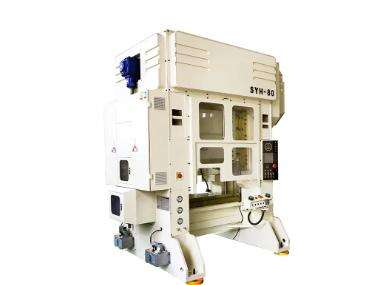
The actual physical structure of the stamping press itself is a factor that determines the capability of stamping complex parts. The extraordinary stability of machines needed in complex jobs is to overcome the high forces used in stamping. Shenzhen Lihao attributes attention to the strength of frame and precise slide systems. A failure of a machine ram to contact a die in its descent may spoil a complicated feature. The shock is absorbed by heavy cast frame high-tonnage presses with long and accurate guides, which keep the upper and lower half die perfectly parallel. This rigidity enables the repetitive piercing and forming even in the high strength material. In the case of manufacturers this would mean an increase in life-span of the die and the ability to push the limits of part design, certain that the machine will offer the necessary force and that it will do so with precision that is uncompromising.
The Economic and Strategic Advantages of Precision Stamping
The investment in the progressive stamping technology that is mother of complex geometries has a huge strategic benefit. The main advantage to the Shenzhen Lihao Machine Equipment Co., Ltd. clients is the possibility to consolidate parts. One complex part that is manufactured in a progressive die can substitute an assembly of several simple parts. This saves on inventory expenditure, eases supply chains, and improves the structural soundness of the end product. Moreover, the rate of progressive stamping implies that large quantities of this complicated components may be stamped with little manpower expenditure. Although the first cost of tooling and equipment might be more, the unit cost per part is reduced by a wide margin with large production volumes. This productiveness enables manufacturers to be competitive, to deliver high quality products without compromising profitability. To produce complex geometry parts in a market that continuously requires more sophisticated and reliable parts, mastering complex part geometry by means of advanced stamping is not merely a technical accomplishment but a highly important business concept.