

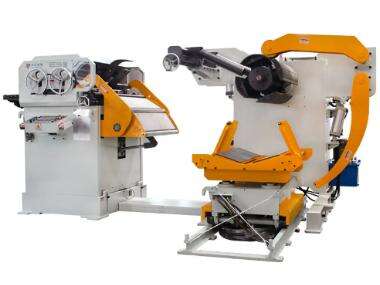
Efficiency and precision are not only objectives in the contemporary manufacturing environment, but they are also survival necessities. In the case of industries that depend on metal forming, the automatic stamping line is the workhorse of such industries. Whereas the stamping press is given a lot of focus, the coil handling system is the unsung hero in a smooth running process. We know that in the case of Shenzhen Lihao Machine Equipment Co., Ltd., the path to a thousand quality parts is the path of one, well-managed coil. The ability to master the coil control is the key to the successful attainment of the throughput and consistency assured by the present market.
Ensuring Continuous Production Flow
The main benefit of an automatic stamping line is that it should not be interrupted. But, this continuous flow entirely relies on the flow of material that is smooth. In cases where coil control has not been considered, the line is subjected to frequent stoppages because of the misfeeds of the material, looping failures, or the slipping of the coil. Any interruption, however short, causes a chain effect of downtime that swallows up production quotas. Manufacturers do that by applying the effective coil handling solutions so that the material flows out in an even and uniform manner. This uniformity has enabled the press to run at maximum speed without incurring expensive hiccups that are common with less efficient systems.
Protecting Product Quality and Dimensional Accuracy
In stamping there is a direct relationship between the quality of the product output and the stability of the input. Unless the coil is adequately controlled as it flows into the press, it may cause misregistration (the stamping die striking the material at an incorrect location). This leaves behind scrap material and it even may spoil costly tooling. Close control of the coils ensures the accurate positioning and tension to ensure each press of the press lands in its proper location. This type of accuracy ensures that all components manufactured are of high dimensional control and minimizes wastage and maintains the reputation of the manufacturer of high quality components.
Maximizing Operational Safety
In a high-speed manufacturing setting, safety is an important issue. Unregulated coils may be unforeseeable and hazardous. An unwound coil that forms a loop and then suddenly tightens may result in whipping or snapping of materials that presents a great danger to the personnel and equipment around that area. Modern coil control systems are intended to solve these issues by circumventing slipping tension and abrupt accelerations. Moreover, automated loading and threading capabilities limit the ability of operators to be close to heavy and moving steel to set up. Investment in better coil handling is thus, an investment in a safer more secure working environment.
Reducing Material Stress for Better Part Formation
The coils of metals leave the mill with internal stress and unwinding may cause further strain when not done carefully. Here the idea of coil control goes beyond the food feed. The correct equipment consists of straighteners with servo-feed systems, which are used to drive out coil set and equalize the stress throughout the width of the material. With a properly leveled, controlled tension coil fed the material is predictable under the press. This minimizes the problem of spring-back and cracking, which enable the ability to produce intricate shapes without wrongfully affecting the structure of the metal.
Optimizing Overall Equipment Efficiency
Finally, the significance of the coil control may be evaluated based on its effect on Overall Equipment Effectiveness. The coil handling line that has a better coil handling is having fewer jam, reduced setup time between the coil changes, and is also having lesser material wastage. All these directly lead to an increased OEE score, that is, the equipment is operating as near to its full potential as possible. The point where the stamping process starts is one of the best returns when a company decides to increase profits or scale operations. It accentuates the stamping line into a highly plucked, profit making machine.
Conclusion
The stamping line is becoming more sophisticated in speed and accuracy and thus margin of error is narrowing down. Coil regulation is no more a preparation process; it is part of the manufacturing strategy. At Shenzhen Lihao Machine Equipment Co., Ltd., we will strive to equip manufacturers with equipment that will enable them to have full control of their material even at its inception. With stability of the coil feed and accuracy, businesses are able to open up new areas of efficiencies, quality, and safety in their stamping processes.