

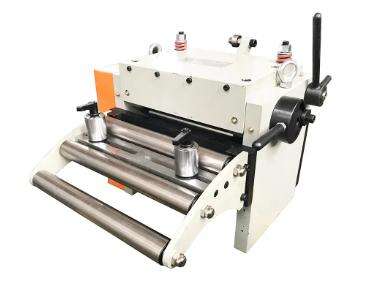
The issue of precision is not merely an objective in the contemporary world of the metal stamping and roll forming; it is the minimum competitiveness standard. The core of this precision is the servo feeder, which is a very vital part determining the quality and consistency of the final product. In the case of manufacturers such as Shenzhen Lihao Machine Equipment Co., Ltd., it will be important to comprehend the factors that make feeding solutions to provide solutions that are up to the very stringent standards of the industry. Accuracy of feeding is not dependent on any single factor but the synergy of a mechanical design, control technology, and stability of operation.
The Mechanical Foundation and Structural Integrity
Precision is based on the physical construction of the servo feeder. It is not a machine that does not have a good mechanical integrity that can hope to produce consistent results with time. The frame and guiding mechanisms need to be designed to absorb the recurring stresses of high speed working without bending and deteriorating. Inflexibility in the material handling route guarantees that the strip inventory is maintained in an exact position, as it is introduced into the die. Also, the accuracy of the rollers and the anti-backlash systems used is crucial. When the rollers have slipping or the drive train is too slack, the error of the roller is multiplied with every cycle. The structural integrity of its systems is a major concern at Shenzhen Lihao Machine Equipment Co., Ltd., because the organization understands that a strong base is the initial move to get rid of variables that affect the accuracy of feed length.
The Role of the Servo Motor and Drive Control
The motif of servo motor and the drive system around it are brains that control movement, although the underlying principle is the mechanics. A servo system has an inherent advantage, which is its closed-loop feedback mechanism. A servo drive is in contrast to an open-loop system since it continuously communicates with the motor and gets real-time position and velocity information. This enables immediate corrections in in case the motor goes off course with its programmed route. The encoder resolution, or the device that measures the rotation of the motor, directly affects the fineness of the system control of movement. An improved resolution enables fine tuning of the feeder, which will get to the right spot, each time. The complexity of the control software is also of importance; complex algorithms will be able to anticipate and correct the response of the mechanical inertia so that acceleration and deceleration curves are not sharp and do not exceed the required length.
Material Handling and Gripping Techniques
The properties of the fed material are already a major variable into the accuracy equation. The thickness, surface smoothness, and even the flatness may vary and this would influence the way the material would behave with the rollers. It is necessary that a servo feeder system adapts to these variances in order to be accurate. The force exerted on the rollers should be enough to cause the material to flow, but no more so as to avoid damaging delicate surfaces. Clamping systems that are pneumatic or servo-controlled need to be able to act and de-act in very specific timings in regard to the stroke of the press. Buckling or distortion may occur in case the release of the material is not timed correctly. The advanced systems have the capability of automatic adjustment of gripping force depending on the parameters of the material used so that a consistent traction is noticed despite the variability of the coil stock.
Integration with the Press and System Synchronization
A servo feeder is also not a vacuum, by itself but a companion of the stamping press. The synchronization between the feeder and the press cycle is very important to the accuracy of the feed. The two machines should exchange electronic communication that is smooth where the feeder clearly receives signals on the time to move forward and during the time to rest. A delay of a milliseconds delay in signal processing can cause a mis-fed part even in high-speed operations. Contemporary systems employ electronic profiles of the cam and real-time communications protocols in order to make sure that the feeding action is choreographed with the press motion. Such integration enables feeding on-the-fly or constant feeding which is more productive as well as preserves the positional accuracy since there are no stop/start shocks that can cause the material to move.
The Impact of Operational Environment and Maintenance
Lastly, the condition under which the equipments work and the regularity of maintenance has a significant contribution in maintaining accuracy in the long-term. Performance can be eroded with time by factors like ambient temperature, vibration by other machinery and the build-up of debris. Changes in temperature have the ability to contract and expand the mechanical components, which can change clearances and tension. Cleaning of rollers, lubrication of bearings and sensor alignment verification are required to maintain the original accuracy specifications which are non-negotiable. The design of its systems is made by Shenzhen Lihao Machine Equipment Co., Ltd. to be durable, yet also with the focus of the active maintenance schedule to its clients. Finally, feeding precision is a dynamic feature that is achieved through the ideal combination of solid design, smart control, flexibly material, smooth assembly, and attentive maintenance, which makes manufacturers able to manufacture parts of high quality with minimal wastage.