

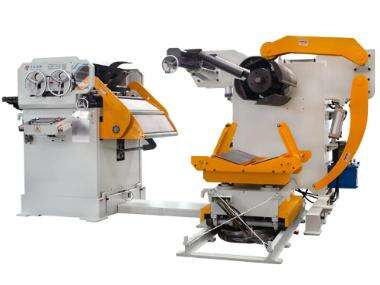
The whole production line, as far as the modern metal stamping and forming industry is concerned, is as strong as the material feed, which is the most fundamental part of it. The central point in any conditioned stamping is the decoiler. In the case of business operations such as that of Shenzhen Lihao Machine Equipment Co., Ltd., manual loading to all-automatic decoiler is a basic upgrade on the actual establishment of the manufacturing line equilibrium. These systems are not add-ons anymore, they are the key to high-speed and high-quality manufacturing.
Eliminating Material Tension Fluctuations
The material tension variation is one of the major coil line stability threats. Any type of coil during unwinding changes its diameter and this means that the amount of pull needed to feed the material on the press or into the leveler is already different. This is usually not compensated in manual systems and the result is jerky moves, slippage of materials or even reverse looping. This is solved by an automatic decoiler system which is designed to hold a constant and closely controlled back tension through the entire coil. This maintains a smooth constant flow of material to the downstream equipment and eliminates the kinds of micro-stoppages and changes in speed that can destroy part precision and cycle times.
Ensuring Continuous, Uninterrupted Production Runs
Profitability is the foe of production down time. The need to stop the line each time a new, heavy coil was loaded was a necessary evil in the past that caused major instability each time the line was started. The current automatic decoilers, especially those which have hydraulic expansion and loading cars, are made to have minimal effect on this disruption. With the ability to change over coils very fast and safely, these systems enable the work to resume in a few seconds. This consistency allows the stamping press or roll former to have a steady-state temperature and operational rate, which is important to create uniform parts and throughput as much as possible during a single shift.
Handling Heavy Loads with Precision and Safety
Coil lines frequently handle material, which is not only heavy, but delicate in regard to the surface finish requirements. Physical stability of the line is determined by the business of holding the coil and turning it. An automatic decoiler is constructed with solid construction similar to the equipment of Shenzhen Lihao with highly synchronized expansion mechanisms to ensure the coil is centered in its perfect location. This gets rid of wobble and vibration on unwinding. Lateral notch rotates When the coil rotates true and the mandrel holds the inner diameter with an effective grip, the rotating has no lateral shifting. This accuracy machining prevents damage to the edges of the material and furthermore, this is a compulsory part of having high-speed progressive die work since the strip must enter into the straightening section without any damage or defect.
Reducing Manual Intervention and Human Error
One of the major causes of instability of the process is human error. Having brakes or centering coils manually adjusted by eye is a variable that is difficult to control. Guesswork is eliminated by automatic decoiler systems. These systems automatically adapt to the appropriate coil width, diameter and weight, through integrated sensor and programmable logic controller controls. The danger of misalignment is also significantly reduced by eliminating physical contact of the operators with the line when setting it up as well as producing. This automation establishes a consistent and steady atmosphere in which the operator is not needed to determine the consistency of the feed but the machine.
Optimizing the Infeed Process for High-Speed Operations
The stamping presses and roll formers are getting faster, thus, putting pressure on the decoiler. A typical decoiler will find it hard to keep up resulting in a starved feed situation in which the press is waiting to receive material. Automatic systems have increased load capacities and a faster reaction time. They will combine perfectly with loop controls to form a material buffer. This buffer will make certain that there is material to be used even in the instances of sudden draws at high speed at the feeder without causing undue tension. This is the line stability of co-ordinating the decoiler and the feeder so that the whole system can continue to operate at its full design capacity.
Minimizing Wear and Tear on Downstream Equipment
The impacts of a poorly functioning decoiler spill over the line. The changes in tension cause the straightening apparatus and feeder to strain further to counterbalance them and the bearings, gears, and rolls wear out too soon. An automatic decoiler serves as a shock absorber to the rest of the production line because it offers a steady and predictable stream of feed at the very beginning. It shields your precision elements of your press and feed mechanisms against the mechanical strain caused by haphazard unwinding. This not only levels-off production but also increases the life span of your capital equipment and is a serious pay-off on investment in terms of lowering maintenance expenses.
To sum up, the stability that an automatic decoiler system offers is invaluable to manufacturers who want to attain a world-class efficiency. Shenzhen Lihao Machine Equipment Co., Ltd. realizes that a productive coil line is a stable line. By focusing on investing in strong automation at the initial stages of such process, the companies will be able to remove the variables, which result in scrap, downtime, and quality problems, and start building the optimized manufacturing floor.